
Final Communiqué of the Meeting of the Foreign Ministers of Algeria, Tunisia and Egypt on Libya (Tripartite Mechanism of Neighbouring Countries)
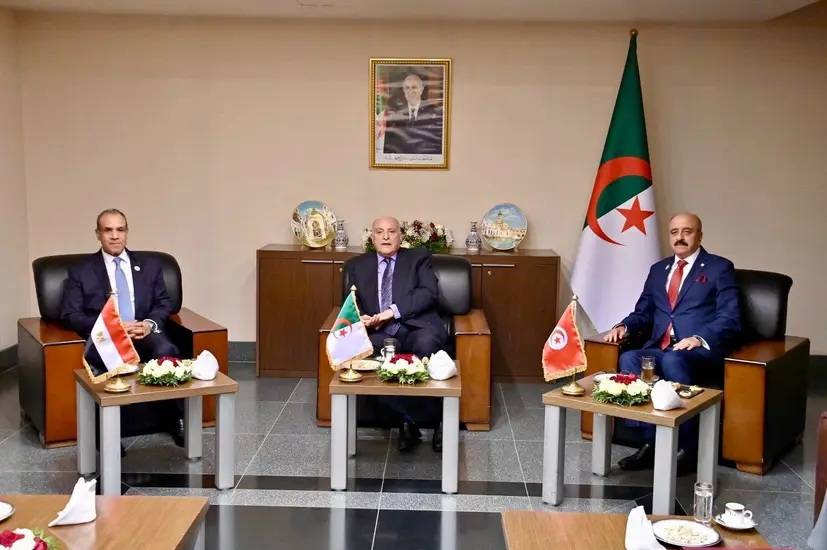
Final Statement of the Meeting of Foreign Ministers
of Algeria, Tunisia, and Egypt Regarding Libya
(Tripartite Neighboring Countries Mechanism)
1. In keeping with the tradition of consultation and coordination, and in implementation of the outcomes of the meeting of the tripartite mechanism of Libya’s neighboring countries—held in Cairo on May 21, 2026—Algeria hosted a meeting on October 25, 2026, for the foreign ministers of Algeria, Egypt, and Tunisia. The meeting, held within the framework of this mechanism, aimed to review developments regarding the Libyan crisis and the prospects for its resolution.
2. The ministers underscored the historical responsibility and central role of the neighboring countries’ mechanism—under the auspices of the United Nations—in supporting the Libyan political process and backing all serious efforts aimed at ending the Libyan crisis. They emphasized the necessity of recognizing the pivotal role of these nations, as they are the countries most directly affected by developments in this neighboring, fraternal state; they possess the deepest understanding of the crisis’s complexities, repercussions, and impacts, and are the most committed to accelerating a comprehensive and fundamental settlement.
3. The ministers expressed their full support for United Nations efforts and international initiatives aimed at facilitating a political process that leads to the holding of simultaneous, free, and fair presidential and parliamentary elections, based on an agreed-upon constitutional and legal framework. Such a process should bring a definitive end to the transitional phases—which have become a de facto reality that only serves to deepen and exacerbate the crisis—and result in the establishment of legitimate, unified, strong, and stable constitutional institutions, thereby putting an end to the current state of institutional division. 4. The Ministers emphasized the necessity of coordinating and integrating regional and international efforts to support an inclusive Libyan political process—facilitated by the United Nations Support Mission in Libya (UNSMIL)—in a manner that strengthens Libyan ownership of the process and contributes to resolving the Libyan crisis.
5. The Ministers addressed the tireless efforts of the UN mission in Libya regarding the implementation of the pillars of the political roadmap announced on August 21, 2025. In this context, they reviewed the outcomes reached by the "4+4" dialogue committee, as well as the framework agreement signed on August 30, 2026.
6. The Ministers stressed that the political process must be Libyan-led and Libyan-owned, and that any political solution must stem from the will and national consensus of the Libyan people, while ensuring the unity, sovereignty, and territorial integrity of the Libyan state.
7. The Ministers reaffirmed their countries' firm and categorical rejection of all forms of foreign interference in Libyan affairs—which has been the primary cause of the crisis’s prolongation and the deepening of divisions among Libyan parties. They further underscored the necessity for the withdrawal of mercenaries, foreign fighters, and foreign forces from the entirety of Libyan territory, the preservation of the gains achieved under the ceasefire agreement, and the acceleration of the unification of all Libyan institutions, including those related to the military and security sectors.
8. The Ministers highlighted the importance of achieving national reconciliation among the Libyan people, expressing their countries' support for the efforts of the relevant Libyan authorities and the African Union—under the auspices of the United Nations—to realize this objective. 9 The Ministers emphasized the importance of safeguarding the resources of the Libyan people, harnessing them to serve their interests, and achieving development and prosperity. They also stressed the necessity of protecting Libya’s frozen financial assets abroad, preserving their value, and ensuring their sound management by the international financial institutions where they are held, in accordance with relevant UN Security Council resolutions. Furthermore, they urged the Libyan parties to take additional steps toward implementing the provisions of the Unified Spending Framework for 2026, which was announced on April 11, 2026.
10 The Ministers agreed to continue coordination and consultation within international and regional bodies and organizations to contribute to the resolution of the Libyan crisis. They underscored the importance of upholding the principles of international law in any agreements, settlements, or understandings that may be reached.
11 At the conclusion of the meeting, the Foreign Ministers of Tunisia and Egypt expressed their sincere gratitude to Algeria for hosting the meeting and for its generous hospitality. The Ministers agreed that the next meeting of this mechanism will be held in the sisterly Republic of Tunisia, on a date to be determined later.
Algiers, October 25, 2026