
Statement by Mr. Ahmed Attaf, Minister of State, Minister of Foreign Affairs, the National Community Abroad and African Affairs, at the consultative meeting of Arab Foreign Ministers
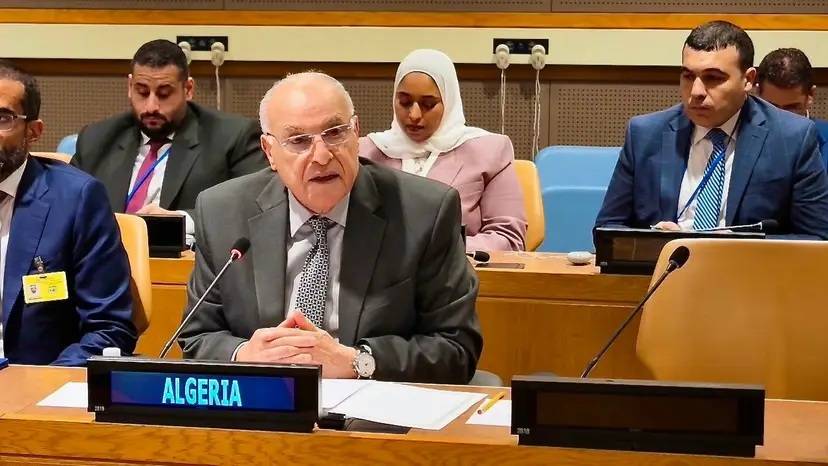
Statement by His Excellency the Minister of State, Minister of Foreign Affairs, National Community Abroad, and African Affairs
During the Meeting of Arab Foreign Ministers
On the Occasion of the 81st Session of the UN General Assembly
In the name of Allah, the Most Gracious, the Most Merciful,
And peace and blessings be upon His truthful and trustworthy Prophet,
Your Excellency, Mr. Mohamed Ali Nafti, Minister of Foreign Affairs, Migration and Tunisians Abroad;
Your Excellencies, Ministers;
Ladies and Gentlemen;
I begin by extending my sincere thanks and appreciation to the sisterly Republic of Tunisia, and to my brother, His Excellency Minister Mohamed Ali Nafti, for chairing this important consultative meeting.
I also thank you for this renewed opportunity to consult and coordinate on the issues concerning our Arab region—issues that will inevitably feature prominently on the agenda of the 81st session of the UN General Assembly.
We meet today amidst a highly sensitive regional situation, where our region is paying the price for the absence of political solutions, the erosion of respect for international law, and the continued selectivity in the implementation of international legitimacy resolutions.
Therefore, our responsibility must not be limited to merely stating positions; rather, we must move towards joint Arab action.
First, the Palestinian cause remains our central issue. The situation in the occupied Palestinian territories—particularly in Al-Quds Al-Sharif and the West Bank—compels us to restore the cause to the forefront of the international agenda and to confront all attempts to marginalize or liquidate it, or to reduce it solely to its humanitarian dimension.
Furthermore, developments on the ground demand that we act with greater urgency than political action alone allows. Of particular note here is the E1 file, as well as political developments in Israel—specifically the elections scheduled for October 27, 2026.
Consequently, our Arab position must clearly reject the transformation of these projects into permanent realities; we must demand practical international action to prevent measures that undermine the possibility of establishing a contiguous and viable Palestinian state. We must also condemn, with equal vigor, Israeli violations of the sovereignty of Arab states, particularly Syria and Lebanon.
Secondly, the ongoing escalation in the Gulf region remains a source of constant concern for us. We reiterate our rejection and condemnation of any aggression against the sovereignty and territorial integrity of Arab states, and of any attempt to turn our region into a theater for proxy wars. We must also emphasize the necessity for Arab states to be part of any discussion or negotiation regarding future security arrangements, ensuring that our priorities and concerns are taken into account.
Thirdly, our preoccupation with dangerous repercussions and recent escalations should not obscure the other crises plaguing a number of our Arab nations. From Libya and Sudan to Yemen and Somalia, we affirm that the common denominator in addressing these crises must be support for national political solutions, the preservation of state institutions, the safeguarding of unity and sovereignty, and the rejection of external interference.
In conclusion, our region needs practical steps rather than further promises; it requires addressing the root causes of the crises afflicting it. With this in mind, Algeria looks forward to a unified, proactive, and effective Arab presence at the eighty-first session—a presence that defends our rights, upholds international law, and simultaneously opens the door to dialogue and political solutions.
Thank you for your kind attention.